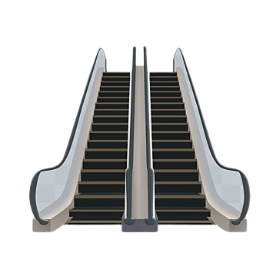
These are powered stairs. They are used when it is necessary to move a large number of people from floor to floor. These stairs run continuously without the need for operators. These escalators are in the form of inclined bridges spanning between floors. The components of an escalator are a steel trussed framework, hand rails and an endless belt with steps. An escalator has a pair of motor-driven sprocket wheels and a worm gear driving machine at the upper ends. At the lower end is a matching pair of sprocket wheels. Two precision-aligned roller chains travel on sprockets pulling an endless belt of steps. Escalators can be reversed in direction. They are usually run at a speed of 30 or 40 meters per minute. Stair slopes are standard at 30°. For a given speed of travel, the tread width determines the capacity of powered stairs.
Escalators should be placed where traffic is heaviest and where it is convenient for passengers. In the design of a new building, adequate space should be allocated for powered stairs. The infrastructure should be properly designed to support them.
Escalators are usually installed in pairs. One of them is used to carry upstream traffic and the other is used for downstream traffic. The arrangement of escalators in each floor can be either parallel or criss-cross. A criss-cross arrangement is more compact. This minimizes the walking distance between stairs at different floors. This is why criss-cross arrangement is preferred over parallel.
Leave a Reply