In arch dams, stability is achieved by a combination of arch and gravity action. If the top face is vertical, the entire weight of the dam must be carried by gravity to the foundation, while the normal hydrostatic pressure distribution between the vertical cantilever and the arch action will depend on the stiffness of the dam in the vertical and horizontal directions. When the upstream face is sloped the distribution is more complicated. The normal component of the weight of the arch ring may be taken by the arch action, while the normal hydrostatic pressure will be distributed as described above. For this type of dam, firm reliable supports at the abutments are more important. The most desirable place for an arch dam is a narrow canyon with steep side walls composed of sound rock. The safety of an arch dam is dependent on the strength of the side wall abutments, hence not only should the arch be well seated on the side walls but also the character of the rock should be carefully inspected.
Two types of single-arch dams are in use, namely the constant-angle and the constant-radius dam. The constant-radius type employs the same face radius at all elevations of the dam, which means that as the channel grows narrower towards the bottom of the dam the central angle subtended by the face of the dam becomes smaller. In a constant-angle dam, also known as a variable radius dam, this subtended angle is kept a constant and the variation in distance between the abutments at various levels is taken care of by varying the radii. Constant-radius dams are much less common than constant-angle dams.
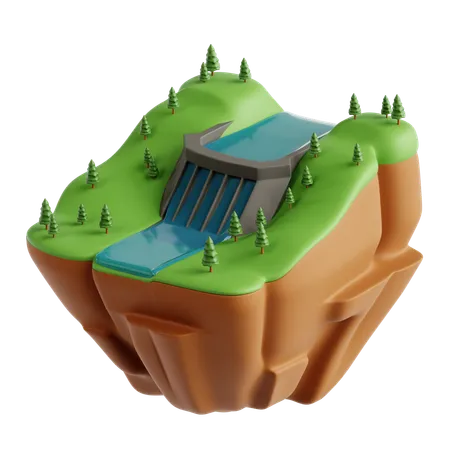
A similar type is the double-curvature or thin-shell dam. This method of construction minimizes the amount of concrete necessary for construction but transmits large loads to the foundation and abutments. The appearance is similar to a single-arch dam but with a distinct vertical curvature to it as well lending it the vague appearance of a concave lens when viewed from downstream. The multiple-arch dam consists of a number of single-arch dams with concrete buttresses as the supporting abutments. The multiple-arch dam does not require as many buttresses as the hollow gravity type, but requires good rock foundation because the buttress loads are heavy.
Leave a Reply