An interactive online tool to calculate the intensity of the magnetic field produced by a solenoid as a result of an electric current flowing in it.
Solenoid Magnetic Field Calculator
This solenoid magnetic field calculator is an interactive online tool specifically designed to calculate the strength of a magnetic field inside air cored solenoids and coils. Magnetic fields consists of invisible lines of force (flux lines) which surround permanent magnets, or in temporary magnets (electromagnets) created when a current flows through a coil of wire.
If we pass an electric current, (I) through a length of straight wire, a small magnetic field is generated around it. The rotational direction of this magnetic field depends upon the direction of the current flowing through the wire. The problem is that the magnetic field produced by these flux lines around the wire is weak and of little practical use.
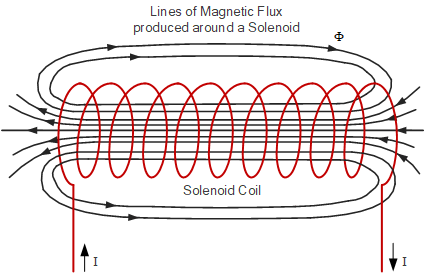
However, bending the straight wire into the form of a single loop, the flux lines are brought closer together and become more concentrated at the center of the loop since all the flux lines inside the loop are aiding in the same direction. If the wire conductor is formed into more than one loop or turn, it produces an electromagnetic coil known commonly as a solenoid as shown.
Solenoid Coil

Then a solenoid is nothing more than a length of wire wound tightly into a long, thin coil, whose length is significantly greater than the size of its diameter. When an electric current of a certain intensity flows through the wire turns of the solenoid, it generates a magnetic field.
The strength of the electromagnetic field created depends on the intensity of the current flowing through the coil turns. Thus the more current, the stronger the magnetic field. Also, more coil turns within a specific length, the more concentrated is the magnetic field.
Ampere-Turns (NI)
Then the magnetic flux, (Φ) produced by a current-carrying solenoid is directly proportional to the product of number of coil turns, (N) and the intensity of the electric current (I) flowing through the coil. The product of N*I is called magnetomotive force (m.m.f) which is measured in Ampere-turns (At).
m.m.f. = N*I Ampere-turns (At)
Thus we can see that the greater is the value of m.m.f., the greater will be the magnetic flux produced by the solenoid (or coil) and vice-versa.
Field Intensity (H)
The Magnetising Force, (H) produced by an electric current flowing through a coil is generally defined as the m.m.f. set up per coil length. Thus if the length, (ℓ) of a solenoid (or coil) with a fixed number of ampere-turns is increased, the intensity of the magnetic field produced will be reduced (become weaker).
Likewise, if we cram a large amount of coil turns into a small volume, the intensity of the magnetic field produced will be increased. Thus the field intensity depends on how long the coil is.
Then magnetic field intensity, H is basically m.m.f. per unit of coil length given in Ampere-turns per meter, or At/m as shown.

Where H is the intensity at the center of an air core.
Permeability (μ)
The intensity of the magnetic flux produced by H depends on the core material used within the solenoid. Thus a good core material will concentrate the lines of magnetic flux more producing a large value of flux density for a specified value of H.
Magnetic flux density (B) is a measure of the concentration of flux within the core and is measured in Teslas, (T). Then we can define the relationship between the magnetising force, (H) and the resulting magnetic flux density, (B) as being.
flux density, B = μH teslas (T)
Where the constant of proportionality μ is the absolute permeability of the material, and has dimensions of henrys per metre (H/m). The permeability of free space of a vacuum is defined as being:
μo = 4π x 10-7 henrys per metre (H/m)
For all practical purposes, the permeability of air (hollow tube) is equal to: μo (“mu nought”). For a coil core with a solid ferromagnetic material, the absolute permeability is given as: μ = μo x μr where μr is the relative permeability of the core material used.
We can use the following magnetic field calculator to find the uniform density B of the magnetic field of a wound solenoid composed of coils of wire wound on a hollow core (that is, without a ferromagnetic core) using the following online calculator:
Magnetic Field Calculator
Solenoid Magnetic Field Calculator

How to Use this Magnetic Field Calculator
How to calculate magnetic field strength. Enter the amount of current, (I) flowing in the coil, in Amperes. Enter the length of the solenoid coil in meters. Enter the number of whole coil turns. The magnetic flux density, (B) is calculated in Tesla (T) using the formula below.

Magnetic Field Calculator Example
A solenoid coil of 15 cm long consists of 500 turns of wire wound around a hollow core. If the coil draws a current of 3 amperes, calculate the value of the magnetomotive force produced by the coil, the magnetic field intensity and the flux density at the center of the solenoid coil.
Data given: N = 500, I = 3A, ℓ = 12cm

Then we have seen in this tutorial that the magnetic flux density B produced in a material is directly proportional to the applied magnetising force H, and the greater the magnetising force, the greater is the flux density and vice-versa.
We have also seen that the magnetomotive force (m.m.f.) specifies the magnetising force caused by a current flowing through one or more coil turns. The value of the m.m.f. expressed in ampere-turns, is proportional to the current and to the number of turns, but the intensity of the magnetic field produced depends on the length of the solenoid coil.
Magnetic field intensity is given as the magnetomotive force per unit of length of the coil and is responsible for the production of the magnetic flux in the solenoid or coil. It is therefore presented as ampere-turns per meter, At/m.
A solenoids magnetic field strength and its flux density are related by the permeability of the core material in which the magnetic field is created. The ratio B/H is always a constant and is equal to the absolute permeability μ of the core material used.
Leave a Reply