Explanation of standard resistor values, preferred resistor values and E-series numbers assigned for colour coded resistors.
Standard Resistor Values
Fixed resistors come in a variety of types, sizes and resistance values. But to have a resistor available for every possible resistance value calculated, literally millions of individual resistors would need to exist. Clearly this is not practical but instead, resistors are manufactured in what are commonly known as Standard Resistor Values, also knon as Preferred values.
The standardisation of resistor values has several major advantages. Instead of sequential values of resistance from say 1Ω and upwards, certain values of resistors exist within certain tolerance bands which are evenly distributed as best as possible on a logarithmic scale. Also, the use of standard resistor values allows compatibility among resistors from various manufacturers for a given design, which initself is advantageous for electrical engineers.
The tolerance band of a fixed resistor is the maximum difference allowed between its actual resistive value and the required or expected resistive value. This difference is commonly expressed as a plus or minus percentage value. For example, a 1kΩ ±20% tolerance resistor may have a maximum and minimum resistive value of:
Maximum Resistance Value at +20% Tolerance
1kΩ, or 1000Ω + 20% (tolerance) = 1200Ω’s
Minimum Resistance Value at -20% Tolerance
1kΩ, or 1000Ω – 20% (tolerance) = 800Ω’s
Then we can see that our 1kΩ ±20% tolerance resistor can have a maximum value of 1200Ω’s or a minimum value of 800Ω’s. That is a difference of some 400Ω’s for the same value resistor and whichever value you choose, it will still be within tolerance.
As we saw in the 4-band resistor colour code calculator tutorial, a fixed resistor’s tolerance value is also identified by a coloured band around its body.
To understand the system of standard resistor values, the mathematical basis behind these “E-series” sets of preferred values comes from the square root value of the actual series being used.
For example, let’s look in detail at the ±20%, E6 series of colour coded fixed value resistors. In the ±20%, (E6) series there are six individual resistors or step values per decade with the size or spread of every step calculated as follows:
E6-series 20% Standard Resistor Values Equation

That is, every resistance value of the E6 series of fixed value colour coded resistors is 1.47 times, or 47% higher (or lower) than the previous standard resistor value in the E6 series, rounded-off to the nearest whole integer number.
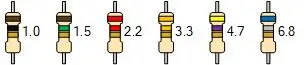
So for example: 1.0 x 1.47 = 1.47Ω’s, rounded up to 1.5Ω’s. and then 1.5 x 1.47 = 2.2Ω’s, etc. Thus the E6 series of standard resistor values looks as follows:
1.0 – 1.5 – 2.2 – 3.3 – 4.7 – 6.8, etc.
Note also that all of these E6 values are available in powers of ten per decade as shown using the 1.5Ω standard resistor value:
Value x Multiplier = Resistance
1.5 x 1 = 1.5Ω
1.5 x 10 = 15Ω
1.5 x 100 = 150Ω
1.5 x 1,000 = 1.5kΩ
1.5 x 10,000 = 15kΩ
1.5 x 100,000 = 150kΩ
1.5 x 1,000,000 = 1.5MΩ
etc.
Decades Scale for Standard Resistor Values
First one small reminder about decades. A decade is a tenfold increase (multiply by 10) or tenfold decrease (divide by 10) per unit value. That is, a decade is a 10 times (x10) change in value.
Thus on the logarithmic scale, 0.1 to 1.0 represents one decade, whereas 1.0 to 100 represents two decades (1.0 to 10 (1 x 10) and then 10 to 100 (10 x 10)). Thus, for a fixed value resistors E-series rating means that every decade (0.1-1.0, 1-10, 10-100, etc.) is divided into equal segments along a logarithmic scale as shown.
E6 Series Decade Scale

So for the E12 10% series there will be twelve individual resistors or steps from 1.0 to 8.2, and is therefore given as the twelfth root of ten ( E12 = 12√10 ) and so on, for the remaining E-series values.
Generally, 4-band resistors will have standard values in the E12 series, while 5-band resistors will have standard values in the E24 series. Note that the higher the E-series number gets, the less is the tolerance value and the more standard resistor values there will be per single decade.
E6 Series Table (6√10)
| E6 Series at ±20% Tolerance – Resistor values in Ω | |||||
|---|---|---|---|---|---|
| 1.0 | 1.5 | 2.2 | 3.3 | 4.7 | 6.8 |
E12 Series Table (12√10)
| E12 Series at ±10% Tolerance – Resistor values in Ω | |||||
|---|---|---|---|---|---|
| 1.0 | 1.2 | 1.5 | 1.8 | 2.2 | 2.7 |
| 3.3 | 3.9 | 4.7 | 5.6 | 6.8 | 8.2 |
E24 Series Table (24√10)
| E24 Series at ±5% Tolerance – Resistor values in Ω | |||||
|---|---|---|---|---|---|
| 1.0 | 1.1 | 1.2 | 1.3 | 1.5 | 1.6 |
| 1.8 | 2.0 | 2.2 | 2.4 | 2.7 | 3.0 |
| 3.3 | 3.6 | 3.9 | 4.3 | 4.7 | 5.1 |
| 5.6 | 6.2 | 6.8 | 7.5 | 8.2 | 9.1 |
E48 Series Table (48√10)
| E48 Series at ±2% Tolerance – Resistor values in Ω | |||||
|---|---|---|---|---|---|
| 1.0 | 1.05 | 1.1 | 1.15 | 1.21 | 1.27 |
| 1.33 | 1.4 | 1.47 | 1.54 | 1.62 | 1.69 |
| 1.78 | 1.87 | 1.96 | 2.05 | 2.15 | 2.26 |
| 2.37 | 2.49 | 2.61 | 2.74 | 2.87 | 3.01 |
| 3.16 | 3.32 | 3.48 | 3.65 | 3.83 | 4.02 |
| 4.22 | 4.42 | 4.64 | 4.87 | 5.11 | 5.36 |
| 5.62 | 5.9 | 6.19 | 6.49 | 6.81 | 7.15 |
| 7.5 | 7.87 | 8.25 | 8.66 | 9.09 | 9.53 |
E96 Series Table (96√10)
| E96 Series at ±1% Tolerance – Resistor values in Ω | |||||
|---|---|---|---|---|---|
| 1.0 | 1.02 | 1.05 | 1.07 | 1.1 | 1.13 |
| 1.15 | 1.18 | 1.21 | 1.24 | 1.27 | 1.3 |
| 1.33 | 1.37 | 1.4 | 1.53 | 1.47 | 1.5 |
| 1.54 | 1.58 | 1.62 | 1.65 | 1.69 | 1.74 |
| 1.78 | 1.82 | 1.87 | 1.91 | 1.96 | 2.0 |
| 2.05 | 2.1 | 2.15 | 2.21 | 2.26 | 2.32 |
| 2.37 | 2.43 | 2.49 | 2.55 | 2.61 | 2.67 |
| 2.78 | 2.8 | 2.87 | 2.94 | 3.01 | 3.09 |
| 3.16 | 3.24 | 3.32 | 3.4 | 3.48 | 3.57 |
| 3.65 | 3.74 | 3.83 | 3.92 | 4.02 | 4.12 |
| 4.22 | 4.32 | 4.42 | 4.53 | 4.64 | 4.75 |
| 4.87 | 4.99 | 5.11 | 5.23 | 5.36 | 5.49 |
| 5.62 | 5.76 | 5.9 | 6.04 | 6.19 | 6.34 |
| 6.49 | 6.65 | 6.81 | 6.98 | 7.15 | 7.32 |
| 7.5 | 7.68 | 7.87 | 8.06 | 8.25 | 8.45 |
| 8.66 | 8.87 | 9.09 | 9.31 | 9.53 | 9.76 |
Hopefully by now we understand that resistors come in standard resistor values, also known as preferred values, as a result of their E-series which designates the quantity of logarithmic steps per decade.
While not given here, E192 series resistors have 0.1%, 0.25%, and 0.5% tolerance bands for high precision resistors. For the E192 series, the values of the formula: 192√10 (1.012 or 1.2% tolerance) are rounded-off to 3 significant figures.
Leave a Reply