An interactive online tool to calculate the resistance value based on the 4 coloured bands of a fixed value resistor.
4-band Resistor Colour Code Calculator
- 4 Band Resistor
- 5 Band Resistor
- 6 Band Resistor
This 4-band resistor colour code calculator is an interactive online tool specifically designed to calculate the resistive value of a fixed value 4-band resistors using the coloured bands on its body. If your a student, engineer or maker having trouble understanding resistor colour codes, then this tool is designed to help you.
4 BAND RESISTOR

INPUTS
| 1st Digit | 2nd Digit | Multiplier | Tolerance | |
|---|---|---|---|---|
| Black | 0 | x1 | ||
| Brown | 1 | 1 | x10 | ± 1% |
| Red | 2 | 2 | x100 | ± 2% |
| Orange | 3 | 3 | x1K | |
| Yellow | 4 | 4 | x10K | |
| Green | 5 | 5 | x100K | ± 0.5% |
| Blue | 6 | 6 | x1M | ± 0.25% |
| Violet | 7 | 7 | x10M | ± 0.10% |
| Grey | 8 | 8 | x100M | ± 0.05% |
| White | 9 | 9 | x1G | |
| Gold | ÷ 10 | ± 5% | ||
| Silver | ÷ 100 | ± 10% |
OUTPUT
Resistance: 5.60k ohms
Tolerance: ± 5%
How to Use the 4-band Resistor Colour Code Calculator
To use this online 4-band resistor calculator tool, simply click on a particular colour and number and watch how the actual bands on the resistor illustration above change. For each coloured band, select the matching colour in the table column indicating the band number and its resistance value.
The resistance value is given in the range of Ohm’s, Kilo-ohms (kΩ), and Mega-ohms (MΩ), and is displayed on the resistor image above, together with the tolerance.
How To Read a 4-band Resistor Colour Code
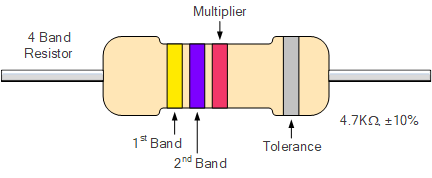
The easiest way to identify a resistor colour code is to know which colours represent the most significant digits. Resistor colour code markings are always read one band at a time starting from the left to the right, with the larger width tolerance band oriented to the right side indicating its tolerance.
By matching the colour of the first band with its associated number in the digit column of the colour chart below the first digit is identified and this represents the first digit of the resistance value.
4-band Resistor Markings

4 Band Resistors Color Code Table
| Colour | 1st Band | 2nd Band | Multiplier | Tolerance |
|---|---|---|---|---|
| Black | 0 | 0 | 1Ω | |
| Brown | 1 | 1 | 10Ω | ± 1% |
| Red | 2 | 2 | 100Ω | ± 2% |
| Orange | 3 | 3 | 1KΩ | |
| Yellow | 4 | 4 | 10KΩ | |
| Green | 5 | 5 | 100KΩ | ± 0.5% |
| Blue | 6 | 6 | 1MΩ | ± 0.25% |
| Violet | 7 | 7 | 10MΩ | ± 0.1% |
| Grey | 8 | 8 | 100MΩ | |
| White | 9 | 9 | 1GΩ | |
| Gold | 0.1Ω | ± 5% | ||
| Silver | 0.01Ω | ± 10% |
Fixed Resistor Tolerance Value
A Resistors Tolerance value determines the maximum percentage change in resistance between the actual measured resistive value and its nominal fixed value. For example, a 100Ω carbon resistor with a ±10% (E12) resistance tolerance can have a resistive value anywhere between 90Ω’s (100 -10%), and 110Ω’s (100 + 10%).
Tolerance value is due to the resistors manufacturing processes and it is always expressed as some percentage of its preferred value. In many electrical and electronic circuits, resistors with a tolerance value of 1% (E96), 2% (E48) or 5% (E24) are normal.
Leave a Reply