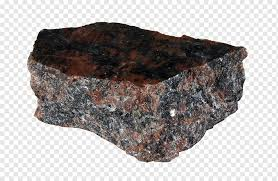
These rocks are formed by changes in the character of pre-existing rocks. Igneous as well as sedimentary rocks change character when they are subjected to intense heat and pressure. The process of change is called metamorphism.Gives names of original and metamorphic rocks. The mineral composition and composition of a rock represents a system in equilibrium with its physiochemical environment. Increases in temperature and pressure disturb this equilibrium and metamorphism results in an attempt to re-establish a new equilibrium. In this process, the original constituent minerals, which are unstable under altered conditions, are transformed into new minerals, which are more stable under altered conditions. These minerals are arranged in a way, which is more suitable for the new environment. However, it should be noted that climate change and sedimentary changes are not included in metamorphism.
There are three agents of metamorphism, namely heat, pressure and chemically acting fluids. Heat may be supplied by the general rise of temperature with depth or by igneous magma. Pressure may be developed due to the load of rocks or movement of the earth. Chemically acting fluids play a passive role only and they do not take active part in the process of metamorphism. Pressure may be uniform or directed. Uniform pressure may be applied to solids and liquids. Directed pressure or stress can exist only in solids and it is converted into uniform pressure if applied to liquids. Following are the four types of metamorphism that occur with various combinations of heat, uniform pressure and directed pressure.
- Thermal metamorphism: Heat is the predominant factor in this type of metamorphism.
- Cataclastic metamorphism: At the surface of the earth, temperature is low and metamorphism is brought about by directed pressure only. Such metamorphism is known as cataclastic metamorphism.
- Dynamo-thermal metamorphism: There will always be a rise in temperature with an increase in depth. Hence, heat in combination with stress brings about the changes in the rock. Such metamorphism is known as dynamo-thermal metamorphism.
- Plutonic metamorphism: Stress is effective only up to a certain depth. This is due to the fact that rocks become plastic in nature at certain depths. At great depths, a stage is reached when stress cannot exist as it is converted into uniform pressure because of the plasticity of rocks. Metamorphic changes at great depths are, therefore, brought about by uniform pressure and heat. Such metamorphism is known as plutonic metamorphism.
Leave a Reply